In the rapidly evolving cybersecurity landscape, organizations face a bewildering array of acronyms—MDR, SIEM, XDR, EDR, NDR, and SOC—each promising to enhance your security posture. Understanding the distinctions between these security solutions is critical for building an effective defense strategy. This comprehensive guide demystifies these technologies, comparing managed detection and response services with security information and event management platforms, extended detection and response systems, and other security tools. Whether you're evaluating managed security service providers or building an internal security operations center, this article provides the clarity needed to make informed decisions about protecting your organization from evolving security threats.
What Is MDR and How Does Managed Detection and Response Work?
Managed detection and response (MDR) is a service that combines advanced security technology with expert human oversight to detect, investigate, and respond to security threats in real-time. Unlike traditional security tools that simply generate alerts, MDR services provide comprehensive threat detection, analysis, and remediation, effectively functioning as an extension of your security teams. This proactive approach ensures that security incidents are contained before they escalate into major breaches.
MDR service providers deploy sophisticated security tools across your environment, including endpoint detection and response (EDR) solutions, network detection and response (NDR) systems, and log management capabilities. These tools continuously monitor for suspicious activity, behavioral anomalies, and indicators of compromise. When potential security threats are identified, the MDR provider's security operations center (SOC) analyzes the alert to determine its validity and severity.
The true value of managed detection and response lies in its human expertise component. Security analysts investigate alerts, correlate events across multiple security systems, and apply threat intelligence to distinguish genuine attacks from false positives. When real threats are confirmed, the MDR team coordinates immediate incident response, containing threats, removing malware, and providing detailed forensic analysis. According to MITRE ATT&CK framework, organizations using MDR services reduce their average breach detection time from 287 days to under 48 hours, dramatically minimizing potential damage. For organizations seeking comprehensive managed security service provider solutions, MDR has become the gold standard for proactive threat management.
What Is SIEM and How Does Security Information and Event Management Function?
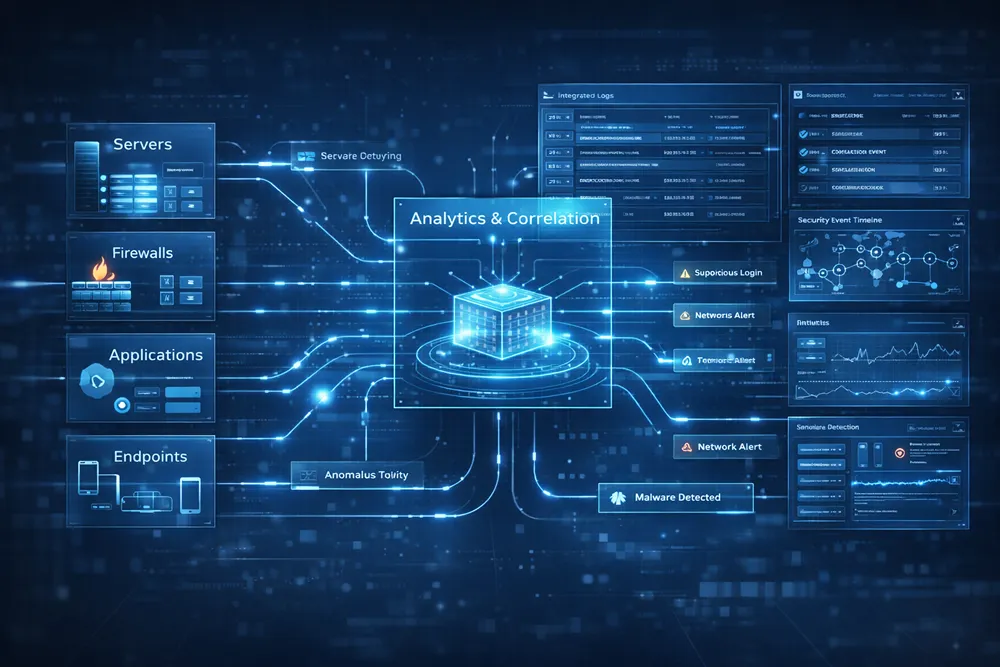
Security information and event management (SIEM) platforms aggregate, correlate, and analyze security data from across an organization's IT infrastructure. SIEM collects log data from firewalls, servers, applications, endpoints, and other security tools, creating a centralized repository for security event management. This unified view of security enables organizations to detect patterns and anomalies that might indicate security incidents.
SIEM solutions perform real-time analysis of security events, applying correlation rules to identify suspicious activities that span multiple systems. For example, a SIEM system might correlate a failed login attempt from an unusual location with subsequent privilege escalation attempts, identifying a potential account compromise that individual security tools might miss. The platform generates alerts when predefined rules or behavioral baselines are violated, enabling security teams to investigate potential threats.
Beyond threat detection, SIEM focuses heavily on compliance and forensic capabilities. The comprehensive log management functionality preserves detailed records of security events, supporting regulatory compliance requirements and post-incident investigations. SIEM platforms generate compliance reports demonstrating adherence to standards like PCI DSS, HIPAA, and SOC 2. However, traditional security information and event management systems have limitations—they require significant tuning to reduce false positives, demand specialized expertise to operate effectively, and primarily provide alerts rather than automated response capabilities. The National Institute of Standards and Technology (NIST) provides frameworks for effective SIEM implementation and security event processing.
What Is XDR and How Does Extended Detection and Response Differ?
Extended detection and response (XDR) represents the evolution of security tools, integrating multiple security layers into a unified platform. XDR provides comprehensive visibility across endpoints, networks, cloud environments, applications, and email systems, breaking down the silos that plague traditional security architectures. This holistic approach enables more accurate threat detection and faster incident response than point solutions operating independently.
Unlike tools like EDR that focus exclusively on endpoints, XDR solutions collect and correlate security data from diverse sources, creating a complete picture of attack campaigns. When an attacker compromises an endpoint, moves laterally across the network, and attempts to access cloud resources, XDR tracks the entire attack chain rather than treating each phase as isolated incidents. This context-rich detection capability significantly improves the ability to identify real security threats while reducing false positives.
XDR platforms incorporate automated response capabilities that can contain threats across multiple security systems simultaneously. When a compromised device is detected, the XDR system can isolate the endpoint, block malicious network traffic, revoke cloud access tokens, and quarantine suspicious emails—all through a single action. Modern security operations centers increasingly rely on XDR to enhance the efficiency of security operations, enabling small security teams to manage complex environments effectively. Research from Gartner indicates that XDR solutions reduce mean time to respond (MTTR) by up to 75% compared to using disparate security tools and platforms.
How Do EDR and NDR Solutions Contribute to Overall Security?
Endpoint detection and response (EDR) solutions focus specifically on protecting individual devices—workstations, servers, mobile devices, and IoT endpoints. EDR to detect malicious activity monitors processes, file operations, registry changes, and network connections on each endpoint, identifying suspicious behaviors that signature-based antivirus misses. Advanced EDR capabilities include behavioral analysis, threat hunting, and forensic investigation tools that provide deep visibility into endpoint activities.
EDR solutions excel at detecting sophisticated attacks like fileless malware, living-off-the-land techniques, and ransomware before encryption occurs. When threats are identified, EDR can automatically isolate infected endpoints, terminate malicious processes, and roll back unauthorized changes. The detailed telemetry collected by EDR provides invaluable context during incident response, enabling security professionals to understand exactly what attackers did, what data they accessed, and how they moved through the environment.
Network detection and response (NDR) complements EDR by monitoring network traffic for threats that might bypass endpoint protections. NDR solutions analyze network flows, packet data, and communication patterns to detect lateral movement, data exfiltration, command-and-control communications, and other network-based attacks. By combining EDR and NDR, organizations gain complete visibility into both on-device activities and network behaviors, significantly enhancing overall security posture. The SANS Institute emphasizes that integrated detection and response services combining EDR, NDR, and other tools provide the most comprehensive security coverage.
MDR vs SIEM: What Are the Key Differences and When Should You Use Each?
The MDR vs SIEM comparison reveals fundamental differences in approach and capabilities. SIEM is a technology platform that requires organizations to build and maintain their own security operations, including hiring security analysts, tuning correlation rules, and developing incident response procedures. In contrast, MDR is a service where external security experts manage threat detection and response on your behalf using various security systems and tools.
SIEM platforms provide powerful data aggregation and correlation capabilities but generate alerts that require human interpretation and action. Organizations implementing SIEM must invest in security expertise to analyze alerts, investigate incidents, and coordinate responses. Many organizations struggle with SIEM due to alert fatigue, with security teams overwhelmed by thousands of daily alerts, most of which are false positives. Effective SIEM operations require continuous tuning, rule development, and threat intelligence integration.
MDR services are designed to provide complete threat management without requiring internal security expertise. The MDR provider deploys security tools (often including EDR, NDR, and sometimes managed SIEM), monitors your environment 24/7, investigates alerts, and takes action to contain threats. For organizations lacking dedicated security teams or those seeking to augment existing security capabilities, MDR offers a faster, more cost-effective path to robust cybersecurity. However, organizations with mature security operations centers and substantial security expertise may prefer SIEM for greater control and customization. CMMC preparation requirements often necessitate comprehensive logging that SIEM provides, though this can be combined with MDR for optimal protection.
MSSP vs MDR: Understanding Managed Security Service Provider Differences
The MSSP vs MDR distinction involves scope and service model differences. Traditional managed security service providers typically offer device management, firewall administration, antivirus deployment, and basic security monitoring. These services focus on managing existing security tools rather than providing comprehensive threat detection and incident response capabilities. MSSPs generally monitor security tools for alerts and notify clients when issues arise, leaving response actions to the client organization.
MDR represents a more advanced evolution of managed security services, emphasizing threat detection, investigation, and active response. MDR providers don't just alert you to problems—they investigate potential security incidents, determine their validity, and take immediate action to contain and remediate threats. This includes isolating compromised systems, blocking malicious communications, and removing attacker access. MDR providers also conduct threat hunting, proactively searching for hidden threats that automated security tools might miss.
Many modern managed security service providers now offer MDR capabilities alongside traditional services, blurring the lines between these categories. When evaluating providers, focus on specific capabilities rather than labels. Key questions include: Do they provide 24/7 monitoring and response? Can they take direct action in your environment? Do they conduct proactive threat hunting? What is their average response time for security incidents? Understanding these details ensures you select services that meet your security requirements. Organizations should also consider security training essential programs to complement managed services, ensuring employees can recognize and report potential security threats.
How Do SIEM and SOAR Technologies Work Together?
SIEM and SOAR (Security Orchestration, Automation, and Response) technologies complement each other to enhance the efficiency of security operations. While SIEM excels at collecting security data and identifying potential threats through correlation, SOAR tools automate response actions and orchestrate workflows across multiple security systems. Together, they enable security teams to respond to security threats more quickly and consistently than manual processes allow.
Security orchestration integrates various security systems, enabling them to share data and coordinate actions automatically. When a SIEM generates an alert for suspicious login activity, a SOAR platform can automatically query the user directory, check recent authentication logs, examine endpoint security status, and search threat intelligence databases—tasks that would take security analysts 20-30 minutes to perform manually. This automation dramatically reduces investigation time while ensuring thorough, consistent analysis.
SOAR platforms enable security teams to codify incident response procedures as automated playbooks. For common security incident types—phishing attacks, malware infections, brute force attempts—SOAR executes standardized response workflows, performing containment actions, collecting forensic evidence, and updating ticketing systems without human intervention. This allows security analysts to focus on complex, unique threats requiring human judgment while routine incidents are handled automatically. Modern security operations centers integrating SIEM solutions with SOAR tools report 80% reductions in mean time to respond compared to manual processes, according to Forrester Research.

What Are the Benefits and Limitations of Building an Internal SOC?
A security operations center (SOC) provides centralized management of an organization's security posture through continuous monitoring, threat detection, and incident response. Building an internal SOC offers maximum control over security operations, enabling customization of tools, processes, and priorities aligned precisely with business requirements. Organizations with unique security challenges, strict data sovereignty requirements, or highly regulated environments often benefit from internal SOCs.
However, establishing an effective SOC requires substantial investment. Organizations must hire security professionals across multiple specializations—security analysts, incident responders, threat hunters, and security engineers. The SOC requires 24/7 staffing, necessitating multiple shifts or follow-the-sun coverage models. Technology investments include SIEM platforms, EDR solutions, threat intelligence feeds, forensic tools, and security orchestration systems. The total cost for a medium-sized organization often exceeds $2-3 million annually.
SOC requires continuous training to keep pace with evolving security threats and attack techniques. Security professionals must stay current on emerging vulnerabilities, new malware families, and adversary tactics, techniques, and procedures (TTPs). Many organizations struggle with security talent shortages, facing difficulty recruiting and retaining qualified personnel in competitive markets. For these reasons, hybrid models combining internal security expertise with managed security operations or MDR services often provide optimal outcomes, leveraging external security experts while maintaining strategic oversight internally. Executive protection programs frequently integrate with SOC operations to provide enhanced security for high-value targets.
How Can Organizations Choose Between MDR, SIEM, XDR, and Hybrid Approaches?
Selecting the right security solutions depends on multiple factors including organizational size, security maturity, available resources, and specific security requirements. Small to medium-sized businesses typically benefit most from MDR services, gaining enterprise-grade security operations without the overhead of building internal capabilities. MDR providers also offer predictable costs, typically structured as monthly subscriptions based on monitored assets, making budgeting straightforward.
Organizations with established security teams may prefer implementing XDR solutions to consolidate security tools and improve detection capabilities while maintaining internal control. XDR provides the unified visibility and automated response capabilities that enhance security team effectiveness without outsourcing operations entirely. Companies pursuing this path should ensure they have sufficient security expertise to operate XDR platforms effectively and respond to generated alerts.
Large enterprises or those with stringent compliance requirements often implement comprehensive security solutions combining multiple approaches. A typical architecture might include SIEM for log aggregation and compliance reporting, XDR for unified threat detection across security layers, and supplemental MDR services for threat hunting and after-hours coverage. This hybrid model leverages the strengths of each approach while mitigating individual limitations. When evaluating tools and services, organizations should conduct proof-of-concept testing with real environment data, assess integration capabilities with existing security infrastructure, and verify that chosen solutions align with long-term cybersecurity strategy. The Cybersecurity and Infrastructure Security Agency (CISA) provides frameworks for evaluating security technologies and architecting defense-in-depth strategies.
What Role Does Managed XDR Play in Modern Security Operations?
Managed XDR combines the technological advantages of extended detection and response platforms with the service delivery model of MDR. This approach provides organizations with unified security visibility and automated response capabilities while outsourcing the operational burden to security experts. Managed XDR providers deploy and operate XDR platforms on behalf of clients, monitoring alerts, investigating incidents, and coordinating responses across multiple security domains.
The managed XDR model addresses a critical challenge facing many organizations—they recognize the value of XDR's comprehensive security approach but lack the expertise to operate these sophisticated platforms effectively. XDR solutions generate fewer but more accurate alerts than traditional tools, but those alerts still require skilled analysis to distinguish genuine threats from benign anomalies. Managed XDR services provide the security analyst expertise needed to maximize XDR investment value.
Managed XDR also enables faster deployment and time-to-value compared to building internal XDR operations. Providers handle platform configuration, integration with existing security tools, baseline establishment, and alert tuning—tasks that typically take internal teams months to complete. Organizations gain immediate access to security operations capability while the provider continuously refines detection rules based on observed attack patterns. This approach proves particularly effective for organizations transitioning from disparate security tools to unified platforms, as providers manage the complex migration process while maintaining security coverage throughout.
Frequently Asked Questions About Security Solutions and Services
What is the primary difference between EDR vs MDR?
EDR is a security tool that monitors endpoints and generates alerts about suspicious activity, while MDR is a service that uses EDR and other tools to detect threats and actively respond on your behalf. EDR requires internal security teams to analyze alerts and take action; MDR provides those security teams as a service.
Can SIEM replace the need for a SOC?
No, SIEM is a technology platform that SOCs used to aggregate and analyze security data. A functional SOC requires people, processes, and multiple security tools including but not limited to SIEM. However, managed SIEM services can provide SOC-like capabilities without building internal operations.
How do you determine if your organization needs MDR?
Organizations lacking 24/7 security monitoring, those experiencing high staff turnover in security roles, or companies that cannot afford to build internal security operations centers typically benefit significantly from MDR. If your security teams are overwhelmed with alerts or lack incident response expertise, MDR services can help address these gaps.
Is XDR better than using multiple specialized security tools?
XDR provides advantages in visibility, correlation, and response coordination that disparate tools cannot match. However, "better" depends on organizational context. Organizations with mature security operations and substantial tool investments may not need XDR immediately, while those building new security programs benefit from XDR's unified approach.
What is the typical cost difference between building a SOC versus using MDR?
Internal SOC costs typically range from $2-5 million annually for medium-sized organizations when factoring in personnel, technology, and facilities. MDR services typically cost $5,000-$50,000 monthly depending on environment size and service scope, representing substantial savings while often providing superior coverage through modern security operations centers and advanced security expertise.
Key Takeaways: Understanding Modern Security Solutions
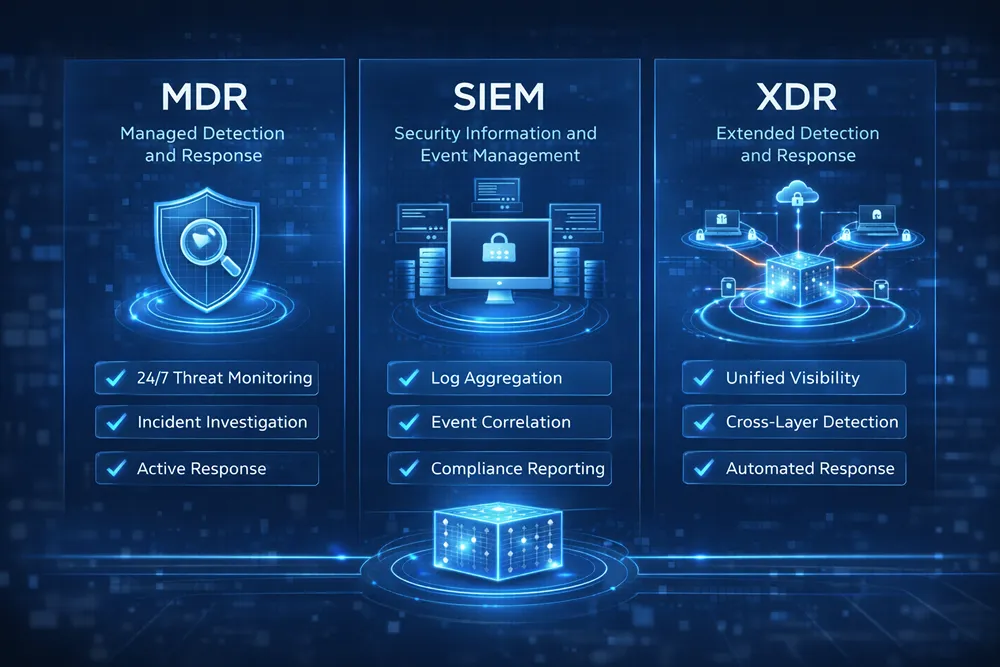
- MDR services provide comprehensive threat detection and incident response as a managed service, combining advanced security technology with expert security analysts who monitor, investigate, and respond to security threats 24/7
- SIEM platforms excel at log management, security event correlation, and compliance reporting but require significant expertise to operate effectively and don't include incident response capabilities
- XDR solutions integrate multiple security layers into unified platforms, providing comprehensive visibility and automated response across endpoints, networks, cloud, email, and applications
- Endpoint detection and response focuses specifically on device-level threats, while network detection and response monitors traffic patterns, making EDR and NDR complementary technologies that together enhance overall security posture
- The MDR vs SIEM comparison highlights that SIEM is a technology platform requiring internal security operations, while MDR is a service that manages detection and response on your behalf using various security systems
- Traditional managed security service providers focus on managing security tools, whereas MDR emphasizes active threat hunting, investigation, and response, representing a more advanced security model
- SIEM and SOAR technologies work synergistically, with SIEM identifying potential security incidents and SOAR automating investigation and response workflows to enhance the efficiency of security operations
- Building internal SOCs provides maximum control but requires substantial investment in security professionals, technology, and ongoing training, making hybrid models attractive for many organizations
- Managed XDR combines XDR technology advantages with MDR service delivery, providing unified security visibility and expert management without requiring internal XDR expertise
- Choosing the right security solutions depends on organizational size, security maturity, available resources, and compliance requirements, with hybrid approaches often delivering optimal outcomes
The evolving security landscape demands sophisticated approaches that combine advanced technology with human expertise. Whether you implement MDR, deploy XDR, leverage SIEM, or adopt hybrid strategies, the goal remains consistent: detect potential security threats rapidly, respond to security incidents effectively, and continuously improve your overall security posture. Organizations must assess their existing security tools, evaluate their security expertise, and select solutions that address gaps while aligning with business objectives and budget constraints.
