As organizations embrace cloud technology to stay competitive, securing the cloud has become one of the most pressing challenges in modern IT. A managed cloud security service delivers the expert oversight, continuous monitoring, and proactive threat management that businesses need to protect their cloud environments without overstretching internal resources. Whether you are running a public cloud, a private data center, or a hybrid cloud setup, understanding how managed security services work — and what they can do for your organization — is essential in today's threat landscape.
This article is worth reading because it goes beyond surface-level definitions. It walks you through the key features of managed cloud security, the core components, real-world benefits, and how to choose the right security provider. By the end, you will have a clear roadmap for how to protect your cloud and strengthen your overall security posture.
What Is a Managed Cloud Security Service and Why Does It Matter?
A managed cloud security service is a model in which a third-party security service provider takes responsibility for monitoring, managing, and protecting an organization's cloud environment. Rather than relying solely on an in-house security team, businesses delegate their cloud security operations to specialists who bring dedicated tools, expertise, and round-the-clock vigilance. The National Institute of Standards and Technology (NIST) Cybersecurity Framework provides the foundational guidelines that most managed security service providers use to structure their cloud security programs.
The importance of this model cannot be overstated. The attack surface of cloud environments grows every time a new workload, application, or user is added. Security teams face a relentless stream of alerts, misconfigurations, and evolving threats across cloud platforms. A managed cloud security service fills the gap by providing continuous security monitoring, incident response, and compliance management — all under a single managed service framework. For businesses without deep in-house security expertise, this approach makes robust security both achievable and cost-effective.
Modern cloud environments are dynamic, distributed, and complex. Cloud data moves across borders, users access cloud resources from dozens of devices, and cloud infrastructure scales up and down in real time. These realities make static, perimeter-based security obsolete. A managed security service provider brings cloud-native tools and deep security capabilities specifically designed for this environment, ensuring that security keeps pace with the speed of cloud operations.

What Are the Key Features of Managed Cloud Security?
Understanding the key features of managed cloud security helps organizations evaluate vendors and set clear expectations. The most effective managed cloud security service providers offer a comprehensive suite of capabilities that cover every layer of the cloud stack.
Continuous security monitoring is the cornerstone of any managed cloud security service. Unlike reactive approaches that only respond after a breach has occurred, continuous monitoring ensures that threats are detected and neutralized in real time. This includes monitoring network security, user activity, cloud configuration changes, and data access patterns across cloud environments. Security operations teams working on behalf of your organization stay alert 24/7, dramatically reducing the window of exposure when security incidents arise.
Another critical feature is cloud security posture management (CSPM). This capability continuously assesses your cloud security posture against industry best practices and compliance benchmarks, identifying misconfigurations and security vulnerabilities before they can be exploited. The Cloud Security Alliance outlines CSPM as one of the most important controls organizations can deploy. Combined with identity and access management, encryption of data stored in the cloud, and automated enforcement of security policies, these features of managed cloud security genuinely reduce risk across every layer of the environment.
What Are the Core Components of Managed Cloud Security?
The components of managed cloud security span multiple technical disciplines and must work together seamlessly to deliver effective protection. The most foundational components include threat detection and response, vulnerability management, compliance monitoring, and identity governance.
Threat detection is powered by advanced security tools including SIEM platforms, endpoint detection and response (EDR), and cloud native application protection platform (CNAPP) technology. A CNAPP consolidates security across the application lifecycle — from development to runtime — and is one of the most important investments an organization can make in modern cloud security. It allows security teams to enforce security controls consistently across cloud assets, workloads, and pipelines.
Incident response for the cloud is another essential component. When a threat is identified, the managed service provider must have a defined, tested playbook for containing, eradicating, and recovering from security incidents. This includes managed detection and response capabilities that go beyond alerting to actively investigate and remediate threats. Paired with vulnerability management that continuously scans cloud infrastructure for weaknesses, these components ensure that managed cloud security services must deliver both prevention and rapid recovery at every stage of an attack.
What Are the Benefits of Managed Cloud Security for Organizations?
The benefits of managed cloud security are significant for organizations of all sizes, but they are especially impactful for small and mid-sized businesses that lack the resources to build a fully staffed in-house security team. Outsourcing cloud security to a specialized provider unlocks access to enterprise-grade security capabilities at a fraction of the cost of building them internally.
One of the most compelling benefits is speed. Managed cloud security helps organizations detect and respond to threats far faster than most in-house teams could manage on their own. When security breaches occur, every minute counts. The financial and reputational impact of security breaches grows significantly with every hour of delayed response. According to the Verizon Data Breach Investigations Report, the speed of detection and containment is one of the single greatest factors in determining breach severity — a managed cloud security service provider with dedicated security operations and mature processes minimizes dwell time and reduces the overall damage substantially.
Compliance is another major benefit. Security regulations such as HIPAA, PCI-DSS, SOC 2, and CMMC require organizations to maintain specific security controls, conduct regular audits, and demonstrate continuous compliance. Managed cloud security services ensure that compliance requirements are built into the security management process rather than treated as an afterthought. This means organizations can access cloud resources with confidence, knowing that their security policies align with regulatory requirements and industry standards at all times.
How Does a Managed Cloud Security Service Protect Your Cloud Assets?
Protecting cloud assets requires a multi-layered approach that addresses threats at the network, workload, data, and identity levels. A managed cloud security service delivers this layered protection by combining security tools, expert analysis, and automated response capabilities into a unified managed service.
At the network level, managed cloud security services provide network security controls that monitor and filter traffic flowing in and out of the cloud environment. This includes firewall management, intrusion detection, and secure access controls that govern who can access cloud resources and under what conditions. Effective cloud security at the network layer prevents unauthorized access to cloud data and reduces the risk of lateral movement by attackers who have gained a foothold in the environment.
At the workload and application level, managed cloud security protects containerized applications, virtual machines, serverless functions, and cloud-native workloads using automated scanning and runtime protection. Security tools continuously analyze the behavior of workloads running across the cloud platform, flagging anomalies that could indicate a compromise. The OWASP Cloud-Native Application Security Top 10 outlines the most critical risks facing cloud workloads today — risks that a managed cloud security service is specifically designed to address. This workload-level visibility is critical in modern cloud environments where applications can scale without manual intervention, making it easy for security vulnerabilities to go unnoticed without automated controls.
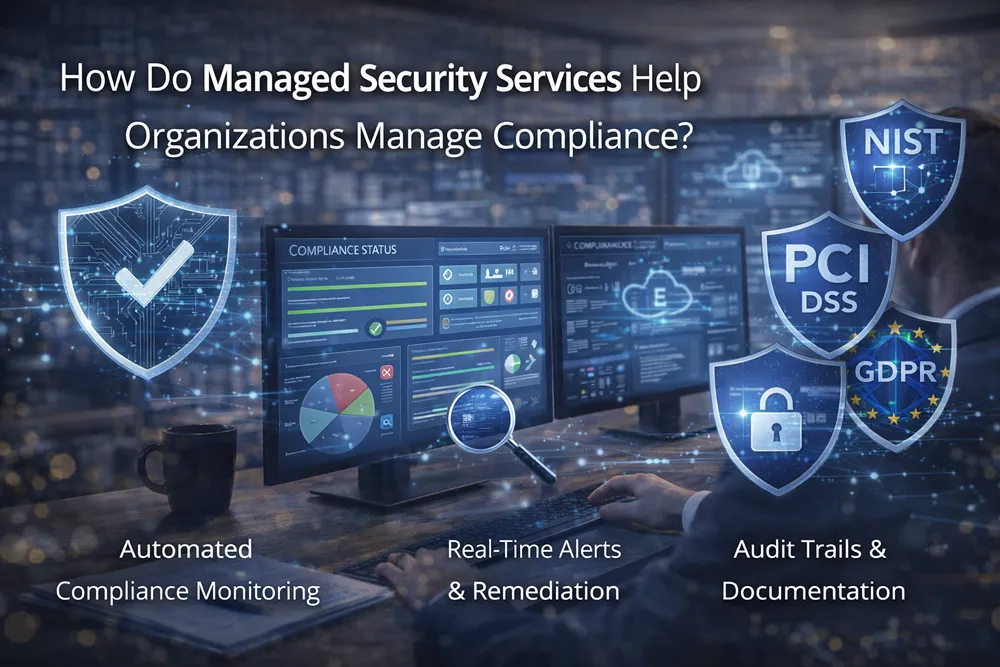
How Do Managed Security Services Help Organizations Manage Compliance?
Managed cloud security helps organizations navigate the complex landscape of compliance by embedding regulatory controls directly into the cloud management and security operations workflow. Rather than conducting compliance assessments once a year, a managed service approach treats compliance as a continuous, automated process.
The managed cloud security service maps security controls to specific compliance frameworks, generating real-time dashboards that show compliance status across the organization's cloud environment. When a configuration drift or policy violation is detected, security teams are immediately alerted and can remediate the issue before it becomes an audit finding. This proactive compliance management approach is far more effective than manual audits and significantly reduces the risk of regulatory penalties. CISA's cloud security best practices provide a strong foundation for the compliance controls that managed cloud security services must implement.
For industries with strict security regulations — such as healthcare, finance, and government contracting — this capability is not optional. These organizations must demonstrate that security ensures the integrity, availability, and confidentiality of sensitive data at all times. A cloud security managed service provides the documentation, audit trails, and automated evidence collection needed to satisfy regulators and demonstrate a mature security posture to clients and partners.
What Security Challenges Do Businesses Face Without Managed Cloud Security?
Organizations that attempt to manage cloud security entirely in-house often encounter serious security challenges that put their business at risk. The most common include talent shortages, alert fatigue, configuration errors, and an inability to keep pace with the evolving threat landscape.
The global shortage of qualified cybersecurity professionals means that many organizations simply cannot hire the security team they need to manage cloud security effectively. Even organizations that do have dedicated security staff often find that their team is overwhelmed by the volume of alerts generated across the cloud environment. Alert fatigue leads to missed threats, delayed responses, and a false sense of security. Outsourcing security to a managed cloud security service provider directly addresses this challenge by providing a team of experts whose sole focus is your protection.
Misconfigurations are the leading cause of cloud data breaches. Research consistently shows that the majority of security incidents in cloud environments stem not from sophisticated zero-day exploits but from simple configuration errors — a storage bucket left publicly accessible, an overly permissive identity policy, or an unpatched vulnerability in a cloud workload. Without dedicated security management tools and expert oversight, these misconfigurations often go undetected for months. A managed cloud security service continuously scans for these issues, reducing the risk of a costly breach significantly.
How Do Managed Security Services Support Hybrid Cloud Environments?
As organizations adopt hybrid cloud architectures — combining on-premises infrastructure with public cloud and private cloud resources — security management becomes increasingly complex. A managed cloud security service is uniquely positioned to provide comprehensive security across these mixed environments.
In a hybrid cloud setup, security policies must be applied consistently across both traditional data center infrastructure and cloud-based workloads. A managed service provider with experience across cloud platforms can enforce security controls uniformly, ensuring that a workload running in Google Cloud, for example, is protected by the same policies as a workload running on-premises. This consistency is critical for maintaining a strong security posture and avoiding the gaps that attackers often exploit at the boundaries between environments.
The ability to manage security across hybrid environments also supports better visibility. Managed cloud security services provide centralized dashboards that aggregate security data from across cloud and on-premises environments, giving security operations teams a single view for monitoring and incident management. This holistic visibility makes it far easier to detect threats that move across cloud boundaries — a tactic increasingly used by sophisticated threat actors targeting organizations that lack comprehensive cloud management oversight.
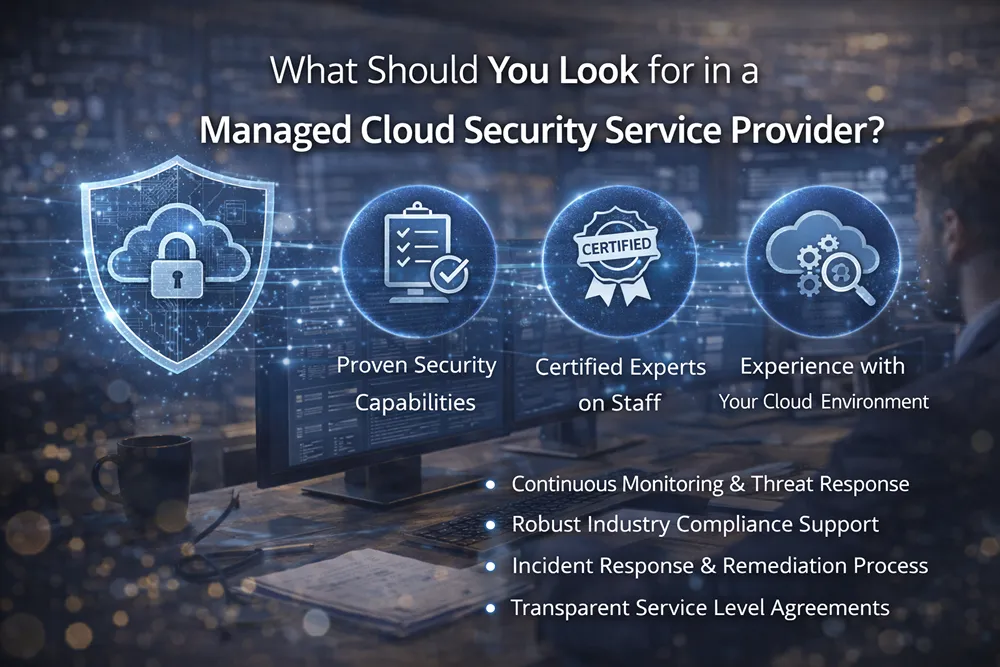
What Should You Look for in a Managed Cloud Security Service Provider?
Choosing the right security provider is one of the most important decisions your organization will make. Not all managed cloud security service providers are created equal, and the quality of the security services you receive will directly determine how well your cloud environment is protected.
Start by evaluating the provider's range of security capabilities. A strong managed security service provider should offer continuous monitoring, threat detection and response, vulnerability management, compliance support, and cloud security posture management as core services. They should have certified experts on staff, proven security tools, and documented processes for security management and incident response. Ask about their average response times, their service level agreements, and how they handle major security incidents. Gartner's cloud security research highlights the capabilities that distinguish leading providers from the rest — it is a valuable resource when evaluating your options.
Also evaluate the provider's experience with your specific cloud environment and industry. A security service provider with deep experience in healthcare cloud security will understand HIPAA requirements, common threat vectors, and the nuances of securing clinical applications in ways that a generalist provider may not. When you consult with potential providers, ask for case studies, references, and demonstrations of their cloud security solutions in action. The right partner will be transparent about their security capabilities and direct about the security challenges your organization faces.
How Can VisioneerIT Security Help You Enhance Your Cloud Security Strategy?
At VisioneerIT Security, we specialize in delivering managed security services tailored to the unique security needs of modern organizations. Our team brings deep expertise in cloud security, compliance, and threat management — giving your business the protection it deserves without the overhead of building everything in-house.
Our end-to-end MSSP offering is designed to manage your security operations from continuous security monitoring and managed detection and response through to compliance management and incident response. We serve organizations across healthcare, finance, government, and small and mid-sized businesses, delivering cloud security solutions that align with your industry's regulatory requirements and real-world threat landscape.
Whether you are just beginning to explore effective cloud security or looking to mature an existing program, our Compliance-as-a-Security Solutions and AI Security Consulting services can help you build a comprehensive, future-ready security posture. To protect your cloud and take the next step forward, get in touch with our team today.
Key Things to Remember
- A managed cloud security service provides expert-led, continuous protection for cloud environments, reducing the burden on in-house security teams.
- The key features of managed cloud security include continuous monitoring, cloud security posture management, threat detection, and incident response for the cloud.
- Core components of managed cloud security cover vulnerability management, compliance automation, identity governance, and workload protection including cloud native application protection platform technology.
- The primary benefits of managed cloud security include faster threat detection, reduced breach impact, simplified compliance management, and access to enterprise-grade security capabilities.
- Managed cloud security helps organizations address configuration errors — the leading cause of cloud data breaches — through automated scanning and real-time remediation.
- A managed service approach supports hybrid cloud environments by enforcing consistent security policies across both on-premises and cloud-based workloads.
- Choosing the right security service provider requires evaluating their range of security capabilities, industry expertise, response times, and overall transparency.
- Outsourcing cloud security to a dedicated managed cloud security service provider is often more cost-effective and more impactful than attempting to build equivalent capabilities entirely in-house.
- Managed cloud security services ensure that compliance is treated as a continuous, automated process rather than a point-in-time audit exercise.
- Organizations looking to enhance their cloud security strategy should consult with an experienced managed security service provider to assess their current posture and close critical gaps.
