When disaster strikes — whether it is a ransomware attack, a natural disaster, a power outage, or a catastrophic system failure — the difference between a business that survives and one that shuts down permanently often comes down to a single factor: preparation. Business continuity and disaster recovery are the two foundational disciplines that determine how quickly and effectively an organization can respond to disruption, protect its people, and resume normal business operations. Yet despite their importance, many organizations treat them as interchangeable terms or, worse, neglect them entirely.
This article is worth reading because it cuts through the confusion. It explains exactly what business continuity and disaster recovery mean, how they differ, how they work together, and what your organization needs to do right now to build a resilient BCDR plan. Whether you are a business leader who has never heard of a recovery time objective or an IT professional looking to strengthen an existing program, this guide gives you the practical knowledge you need to protect your business when it matters most.
What Is Business Continuity and Why Does It Matter?
Business continuity refers to an organization's ability to maintain essential business functions during and after a disruption. Think of business continuity as the broader strategic framework — the overarching plan that ensures your business keeps running even when conditions are far from normal. A business continuity plan covers everything from how employees will work remotely during a facility outage to how customer service will be maintained during a cyber incident.
Business continuity encompasses people, processes, technology, and communication. It is not simply about recovering IT systems; it is about ensuring that every critical business function continues to operate at an acceptable level no matter what type of disruption occurs. Business continuity managers are responsible for identifying which functions are most critical, what resources are required to sustain them, and what procedures need to be in place before disaster strikes.
The importance of business continuity cannot be understated in today's environment. Disruption is no longer a rare event — cyber threats, supply chain failures, extreme weather, and infrastructure outages are increasingly common. A robust business continuity strategy is the foundation on which all other resilience efforts are built, and without it, even the most technically sophisticated disaster recovery solutions will fall short of keeping your business up and running.
What Is a Disaster Recovery Plan and What Does It Cover?
A disaster recovery plan is a documented, structured approach to restoring IT systems, data, and infrastructure following a disruptive event. While business continuity focuses on keeping the broader business operational, disaster recovery is specifically concerned with the technical recovery of systems and data. In this sense, disaster recovery is best understood as a subset of business continuity — an essential component of the larger BCDR framework.
A disaster recovery plan covers the specific steps required to restore business applications, databases, servers, and network infrastructure after a disruption. It defines who is responsible for each recovery task, in what order systems should be brought back online, and what tools and resources are needed. A well-designed DR plan also establishes clear recovery objectives — specifically the recovery time objective (RTO), which defines the maximum acceptable downtime, and the recovery point objective (RPO), which defines the maximum acceptable data loss measured in time.
Every disaster recovery plan should be tailored to the specific risks and recovery requirements of the organization it protects. A financial services firm will have very different recovery priorities than a healthcare provider or a manufacturing company. The disaster recovery plan must reflect these differences, addressing different disaster scenarios — from natural disaster events such as floods and fires to cyber incidents like ransomware — and defining the recovery procedures that apply in each case.

Business Continuity vs Disaster Recovery: What Is the Difference?-
Business continuity vs disaster recovery is one of the most frequently misunderstood distinctions in risk management. While the two disciplines are deeply interconnected, they serve different purposes and operate at different levels of an organization's resilience strategy.
Business continuity is the broader business strategy. It focuses on maintaining critical business operations during a disruption and ensuring that the organization can continue to serve its customers, meet its obligations, and protect its employees regardless of what happens. A business continuity plan addresses not just technology but also people, facilities, supply chains, communications, and business processes. It answers the question: how do we keep the business running?
Disaster recovery, on the other hand, is a technical discipline focused on restoring IT infrastructure and data. A DR plan answers the question: how do we get our systems back online after a disaster? Both are essential, and neither is sufficient without the other. An organization that can keep its people working but has no way to recover its data is just as vulnerable as one that can restore its systems but has no plan for managing business operations after a disaster. A comprehensive business continuity and disaster recovery approach addresses both dimensions together through a unified BCDR plan.
What Is a BCDR Plan and What Should It Include?
A BCDR plan — short for business continuity and disaster recovery plan — is a comprehensive document that combines both disciplines into a single, coordinated framework. It defines the policies, procedures, roles, and resources needed to prepare for, respond to, and recover from any type of disruption that could affect daily business operations.
A strong BCDR plan begins with a thorough business impact analyses process. Conducting a business impact analysis (BIA) allows the organization to identify its most critical business functions, assess the potential impact of different types of disruption, and prioritize recovery efforts accordingly. The BIA informs the recovery objectives for each system and process, ensuring that the disaster recovery team focuses its efforts where they matter most and that recovery resources are allocated effectively.
Beyond the BIA, a complete BCDR plan includes a detailed communication plan, clearly defined recovery team roles and responsibilities, documented backup and recovery procedures, vendor and supplier contact information, and a testing schedule. A plan in place that has never been tested is little more than a document — regular testing, tabletop exercises, and simulations are essential to ensure that the plan will actually work in the event of a disaster. The best practice across the industry is to review and update the BCDR plan at least annually and after any significant change to the business or its technology environment.
Why Is Disaster Recovery Important for Modern Businesses?
The importance of disaster recovery has grown dramatically as organizations have become more dependent on digital systems and data. Today, virtually every business function relies on technology — from customer relationship management and financial processing to supply chain coordination and employee communication. When those systems go down, the impact is immediate and often severe.
The business impact of unplanned downtime extends far beyond the cost of IT recovery. Lost revenue, damaged customer relationships, regulatory penalties, and reputational harm can follow an organization for years after a major disruption. Research has consistently shown that a significant percentage of businesses that experience extended disruption never fully recover. Investing in a comprehensive disaster recovery plan is not just a technical decision — it is a critical business decision that directly affects the long-term survival of the organization.
Cyber threats have made the importance of disaster recovery even more acute. Ransomware attacks, in particular, represent one of the most disruptive threats businesses face today. When attackers encrypt critical data and demand payment for its release, organizations without a solid disaster recovery plan have few options. A robust backup and recovery strategy — including offsite and cloud backup and disaster recovery capabilities — gives organizations the ability to restore from clean backups and avoid paying ransoms, dramatically reducing the business impact of a cyber attack.
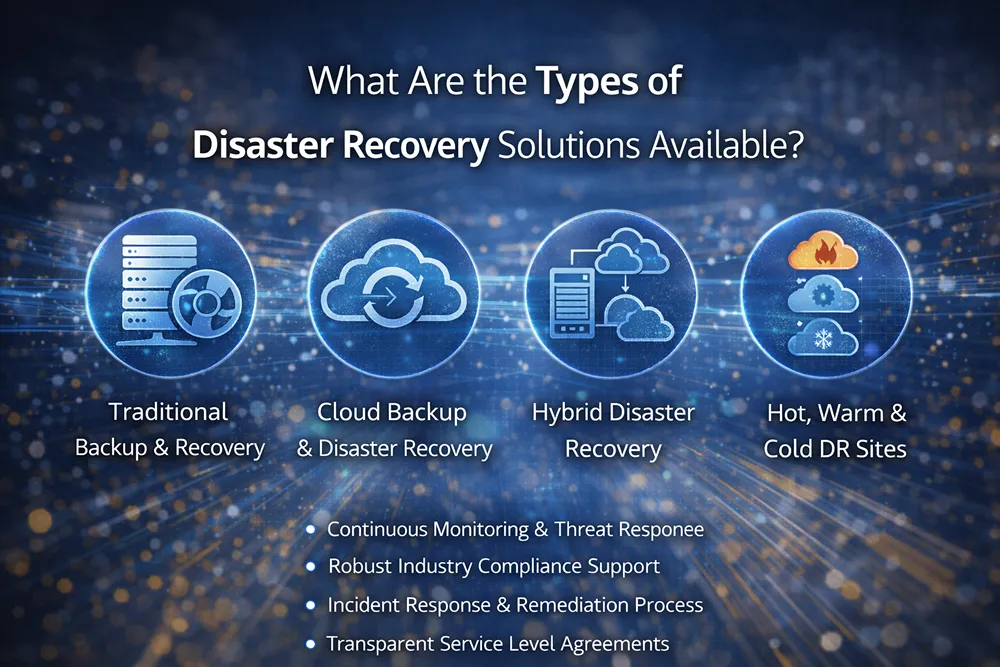
What Are the Types of Disaster Recovery Solutions Available?
Understanding the types of disaster recovery options available is essential for building an effective DR strategy. Recovery solutions have evolved significantly over the past decade, and organizations today have more options than ever for protecting their systems and data.
Traditional disaster recovery relied on physical backup infrastructure — tape backups, secondary data center locations, and manual recovery processes. While these approaches are still used in some environments, they are increasingly supplemented or replaced by cloud-based disaster recovery solutions. Cloud backup and disaster recovery offers significant advantages: lower cost, faster recovery times, geographic redundancy, and the ability to scale resources up or down as needed. High availability and disaster recovery architectures hosted in the cloud can reduce RTOs from hours or days to minutes.
DR strategies vary based on the organization's recovery objectives and risk tolerance. Some organizations opt for hot disaster recovery sites — fully operational secondary environments that can take over instantly in the event of a disaster. Others use warm or cold sites that require more time to activate but cost less to maintain. Increasingly, organizations are moving to hybrid models that combine on-premises infrastructure with cloud-based disaster recovery solutions, giving them flexibility, resilience, and rapid recovery capabilities without the cost of maintaining a full secondary data center.
How Do Business Impact Analyses Drive Recovery Planning?
Conduct business impact analyses is one of the most important steps in developing an effective continuity and disaster recovery plan. A BIA is the process of systematically evaluating the potential consequences of a disruption to each business function, process, and system — and using those findings to prioritize recovery efforts and set recovery objectives.
The business impact analysis identifies which systems and processes are truly critical business operations and which can tolerate longer periods of downtime. It quantifies the financial, operational, and reputational impact of disruption at different time intervals — what happens if a system is down for one hour, one day, or one week? These findings directly inform the recovery time objective and recovery point objective for each system, ensuring that the disaster recovery plan is grounded in real business requirements rather than arbitrary technical targets.
A well-conducted BIA also surfaces dependencies that might not be immediately obvious. A business process that appears straightforward may rely on a system or supplier that, if disrupted, would cascade failures across the entire organization. Identifying these dependencies in advance allows disaster recovery efforts to address them proactively, rather than discovering them mid-crisis when options are limited and pressure is high.
What Are the Best Practices for Building a Robust BCDR Plan?
Building a robust business continuity and disaster recovery program requires more than writing documents and purchasing technology. It requires a disciplined, organization-wide commitment to resilience that is embedded in the culture and governance of the business.
The best practice for BCDR development starts with executive sponsorship. Business continuity plans help organizations survive disruption, but only if leadership treats resilience as a strategic priority rather than an IT checkbox. When business leaders champion the BCDR program, it ensures adequate resources, clear accountability, and the organizational buy-in needed to make continuity and disaster recovery strategies work in practice. Recovery and business continuity plan development should involve stakeholders from across the business — IT, operations, finance, legal, and communications — not just the technology team.
Testing is the most critical best practice of all. A detailed plan that has never been tested will almost certainly fail when it is needed most. Organizations should conduct regular tabletop exercises that simulate different disaster scenarios, testing the communication plan, decision-making processes, and technical recovery procedures under controlled conditions. Data recovery drills, failover tests, and full-scale simulations ensure that both the disaster recovery team and the broader business understand their roles and can execute them under pressure. Each test should generate a lessons-learned report that drives continuous improvement of the BCDR plan.

How Does Cybersecurity Integrate with Business Continuity and Disaster Recovery?
The relationship between cybersecurity and BCDR has never been more important. Cyber incidents — including ransomware, data breaches, and destructive malware — are now among the most common triggers for disaster recovery activation, and organizations that treat cybersecurity and business continuity as separate programs leave dangerous gaps in their resilience posture.
Effective business continuity and disaster recovery planning must account for cyber-specific recovery scenarios. This means maintaining secure, isolated backup copies that cannot be encrypted or deleted by ransomware, establishing clear procedures for cyber incident response that integrate with the broader DR plan, and ensuring that the disaster recovery site itself is hardened against the same threats that may have compromised the primary environment. Without these cyber-aware recovery processes, an organization may successfully restore from backup only to find that the restored environment is immediately reinfected.
Our Managed Security Service Provider team at VisioneerIT Security works closely with organizations to integrate cybersecurity best practices directly into their BCDR planning. From dark web monitoring that detects compromised credentials before they are used in an attack, to phishing awareness and protection that reduces the likelihood of the human errors that often trigger disasters, our services help ensure business continuity by preventing disruptions before they start.
How Can VisioneerIT Security Help You Implement Business Continuity and Disaster Recovery?
At VisioneerIT Security, we understand that effective business continuity and disaster recovery planning is not a one-time project — it is an ongoing program that must evolve alongside your business and the threat landscape. Our team helps organizations across industries create a detailed plan that is practical, tested, and aligned with their specific recovery objectives.
We serve organizations in healthcare, finance, government, education, and small and mid-sized businesses — all industries where the stakes of disruption are particularly high and the requirements for compliance-driven resilience are particularly demanding. Our Compliance-as-a-Security Solutions service ensures that your BCDR program meets the regulatory requirements of your industry, while our Security Awareness Training reduces the human risk factors that most often trigger disasters in the first place.
If you are ready to invest in business continuity and build a resilient future for your organization, contact our team today to get started. We will help you design, implement, and maintain a comprehensive disaster recovery plan to protect everything your business has built.
Key Things to Remember
- Business continuity refers to the broader strategy of keeping critical business functions operational during any type of disruption — it goes far beyond IT systems.
- A disaster recovery plan is a technical subset of business continuity, focused specifically on restoring IT infrastructure, data, and business applications after a disaster.
- Business continuity vs disaster recovery is not an either/or choice — both are essential, and a unified BCDR plan brings them together into a single coordinated framework.
- Conducting a thorough business impact analyses is the critical first step in any BCDR plan, as it identifies recovery priorities and informs recovery objectives.
- Recovery time objective (RTO) and recovery point objective (RPO) are the two most important metrics in disaster recovery planning — every DR strategy must be built around them.
- The types of disaster recovery solutions available range from traditional secondary data centers to modern cloud backup and disaster recovery platforms offering rapid recovery at lower cost.
- Cybersecurity and business continuity are deeply interconnected — cyber incidents are now among the most common triggers for disaster recovery activation, and BCDR plans must address them explicitly.
- Testing is the most critical best practice in BCDR — a plan that has never been tested will almost certainly fail when disaster strikes.
- Business continuity plans help organizations avoid the permanent closure that often follows extended disruption — investing in resilience is investing in the long-term survival of the business.
- Minimizing business disruption requires an organization-wide commitment to resilience, with executive leadership, cross-functional involvement, and regular plan reviews built into the program.
